
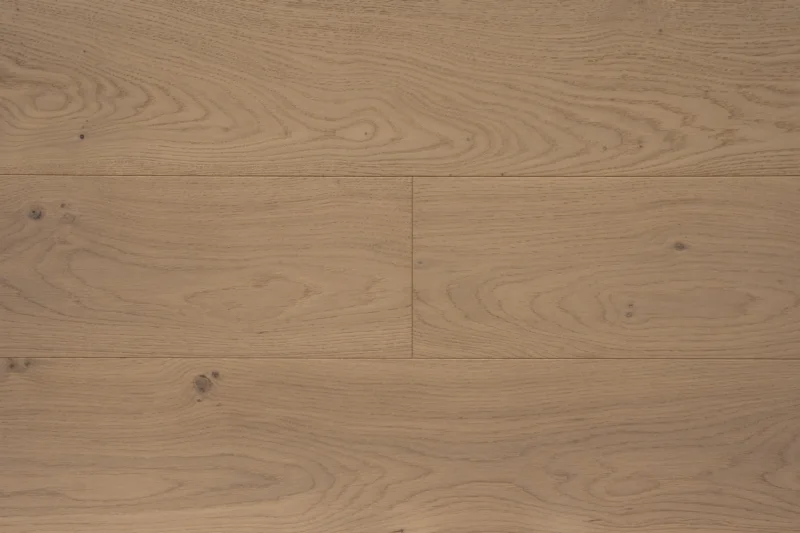
When people talk about “hardwood flooring,” they are often referring to one of two distinct products: solid hardwood and engineered hardwood. Both carry a real hardwood surface and both produce a floor that looks and feels like wood — but they differ significantly in construction, performance, and where they can be used. Understanding the difference is essential to choosing the right product for your home.
Solid Wood Floors
Solid hardwood flooring is exactly what it sounds like: a single, homogeneous piece of hardwood milled to a uniform thickness, typically 18–22mm. It is available in a wide range of species — oak, walnut, cherry, maple, and many others — and in various grades from tight-grained prime (minimal knots or colour variation) to characterful rustic (natural knots, grain movement, and colour range). Boards come with tongue and groove profiles on all four edges to allow the floor to be laid continuously across a room.
Solid wood must be mechanically fixed to a timber subfloor — either secret-nailed using a portanailer machine through the tongue, or occasionally adhered using elastic polyurethane adhesive. It cannot be floated. This means it is not directly suitable for installation over concrete without an intermediate timber raft, and it is generally not recommended over underfloor heating because of the severe drying and contraction that UFH causes. When properly specified, installed, and maintained, solid wood floors can be sanded and refinished many times over, giving them a lifespan of 80–100 years or more.
Engineered Wood Floors
Engineered hardwood flooring uses a real hardwood top layer (the “wear layer”) bonded to a multi-ply plywood core and a balancing backing layer. The top layer is typically 3–6mm of genuine hardwood — the same species you would find in a solid board — giving the floor an identical appearance and much of the tactile character of solid wood. The critical difference is the cross-ply plywood core: alternating layers bonded with opposing grain directions that resist expansion and contraction, making engineered boards dimensionally far more stable than solid wood.
This stability opens up applications that solid wood cannot access: concrete subfloors, underfloor heating systems, below-grade rooms, and installations where a floating floor (not mechanically fixed) is required. Engineered boards can be clicked or tongue-and-grooved together and floated over acoustic underlay, or fully bonded to the subfloor with adhesive. They are generally easier and quicker to install than solid boards, and suitable for a wider range of properties and subfloor conditions.
How to Choose Between Them
The right choice depends on your subfloor, your heating system, and your priorities for the floor’s long-term life. Choose solid wood if you have a timber subfloor in a stable, well-managed environment and want maximum refinishing potential over many decades. Choose engineered wood if you have a concrete subfloor, underfloor heating, or need a more versatile specification — particularly in new-build or basement conversions where solid wood’s constraints would otherwise rule it out. In terms of appearance and everyday character, the two products are functionally indistinguishable in the rooms where both can be used.
Grades, Species, and Finishes
Both solid and engineered floors are available across a wide range of species, grades, and finishes. Grade refers to the visual character of the board: prime or select grade features very consistent colour and minimal knots; character or rustic grade includes natural features such as knots, colour variation, and sapwood streaks. Neither grade is superior in terms of durability — it is a purely aesthetic classification. Finish (lacquer, hardwax oil, brushed and oiled, or unfinished) is applied equally across both product types. Most flooring sold today is pre-finished at the factory, which saves considerable time and disruption compared to site-finishing.