
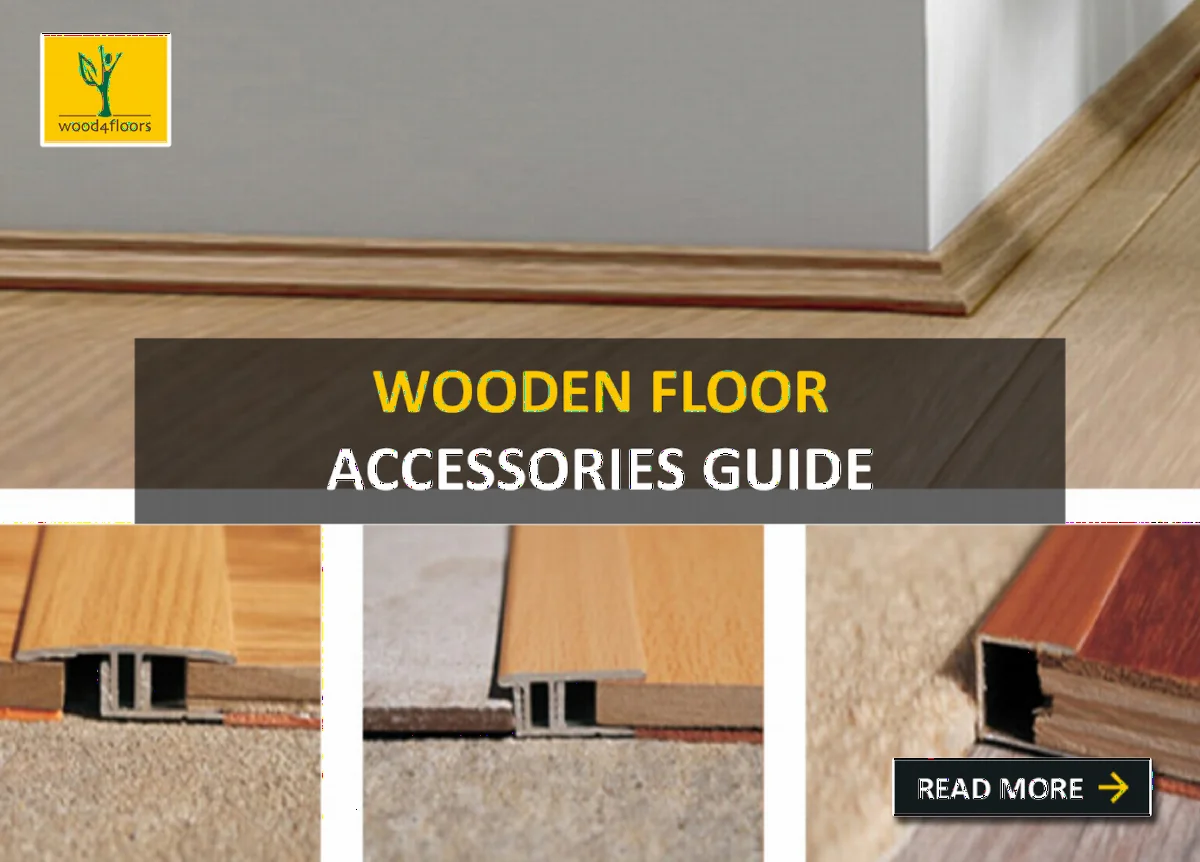
A quality wood floor installation involves more than just the boards and the underlay. A range of accessories is needed to complete the finish — covering expansion gaps, bridging level changes, protecting pipe penetrations, and creating clean transitions between different floor surfaces. If you are specifying or buying flooring for the first time, some of these products have names that are not immediately obvious. Here is a guide to everything you are likely to need.
Scotia and Beading
Scotia (also known as quadrant or beading) is the trim used to cover the expansion gap between the edge of the flooring and the skirting board. This gap — typically 8–12mm — must be left around the entire perimeter of a floating floor to allow the boards to expand and contract with humidity changes. If the gap is not covered, it looks unfinished and can accumulate dust. Scotia is pinned to the skirting board, not to the floor, so it moves with the wall rather than constraining the floor. It is available in MDF (painted to match the skirting, in a range of colours) or in solid wood species such as oak or walnut to match the floor itself.
Threshold Bars (T-Bars)
A threshold bar — often called a T-bar — is used wherever the wood floor meets a different floor covering at a doorway or room junction. The T-profile spans the gap between the two surfaces, creating a clean, flush transition. T-bars are used where the two floor surfaces are at the same height, as is typically the case where a wood floor meets a tiled hallway or a carpeted room. They are fixed using a channel that is screwed to the subfloor, with the visible aluminium or wood-effect profile clicking or screwing into the channel from above. They are available in a range of colours and finishes to coordinate with the floor.
Reducer Bars (R-Bars)
Where two floor surfaces sit at different heights — for example, where a newly installed 15mm engineered floor meets an existing ceramic tile that sits at a different level — a reducer bar equalises the transition. Reducer bars are designed with an angled profile that ramps smoothly from the higher surface down to the lower one, eliminating the trip hazard that an abrupt height difference would create. Various profiles are available to accommodate different height differentials, typically from 5mm to 25mm. Check the height difference carefully before ordering, as selecting the wrong profile will result in either a poor fit or a visible step rather than a smooth ramp.
Edge Bars (L-Bars)
An edge bar (L-bar) is used to provide a finished edge where the flooring terminates at a step change — such as at a patio door threshold where the floor drops to a step outside, at a fireplace hearth, or at a recessed doormat well. The L-profile holds the end of the flooring down and conceals the cut edge neatly. It can also be used as an alternative to scotia where the gap between the floor edge and the wall is particularly wide or where the skirting board is being replaced as part of the same refurbishment. L-bars are screwed or glued down independently of the floor boards.
Stair Nosings
If you are extending the wood floor onto stairs, stair nosing profiles are essential at the edge of each tread. The nosing creates a smooth, finished edge between the tread surface and the riser below, covering the exposed end-grain of the boards and providing a slightly rounded, slip-resistant leading edge. Stair nosings are typically 1m lengths in matching oak or walnut, and can be screwed or adhered to the stair tread. Measure the rise and tread dimensions carefully before ordering — nosing profiles vary in the vertical depth they cover, and selecting the right profile for your stair geometry ensures a neat, gap-free result.
Radiator Roses
Radiator roses are small circular collars that fit around the pipes where a radiator connects to the floor. These pipes typically pass through the floor, requiring a cut in the board around each pipe — and the rose covers this cutout neatly, preventing a visible gap and stopping dust from falling into the void below. They are available in various diameters to match standard pipe sizes (typically 15mm and 22mm) and in materials and finishes to match the floor. Fitting roses is a small detail, but it is the kind of finish that distinguishes a professionally completed installation from a DIY job that looks rushed.
Underlay and Adhesives
Beyond the accessories above, most installations also require underlay (for floating floors) or adhesive (for glued-down installations). Standard underlays for floating floors are typically 2–3mm foam or fibre; acoustic underlays are thicker with rated impact noise reduction. For UFH, always check the underlay’s thermal resistance (tog) rating — high-tog underlays significantly reduce heating efficiency. Elastic polyurethane adhesive is used for fully bonded installations; standard wood adhesive is not suitable as it does not allow for the natural movement of the board. If you are unsure what your installation requires, contact us before ordering — selecting the right products from the outset prevents expensive problems later.